
by Jenny Turner & Rosemary Babb
So you’re looking at your cute Samoyed puppy and thinking “this thing should be easy”. Think again. The first thing you will discover is that a puppy is much more interested in playing with the brush than sitting still. However, you must persist, as this is your only opportunity to establish a good grooming habit so that the job is easy when the dog is an adult. Break the grooming up into short brushing sessions followed by short playing sessions. Brush or comb one leg, then have a quick toss of the ball. If puppy is reaching back to eat the brush, gently move his face away and firmly say “no” or “ah-ah”. Or if you can give him something to chew on while you’re grooming, that will help to distract him.
If you have adopted an older dog who is not used to being groomed, he may be scared, so be kind but firm and reward for being calm. If the dog is particularly fearful of the equipment and procedure, start by introducing him to the equipment piece by piece. Let him sniff and touch it. Then brush very gently in a place the dog can see. Reward when the dog lets you do this and work your way up slowly, only moving forward when the dog accepts the last step willingly. Grooming should be a pleasurable experience for the dog, not a frightening one.
The Samoyed is a double coated breed. They have two layers of hair – an outer coat, consisting of harsher/coarser hair which has great weather resistance – and an under coat which is shorter, finer and designed to keep the dog warm while working outdoors. It is mostly this under coat that drops out or sheds.
First you’ll need some equipment. The most basic and easiest to use are a pin brush with rounded ends and a rake or comb with rotating teeth. Buy a comb with rotating teeth whenever possible, as they glide through the hair much easier. And always get rounded ends on the pins of the brush, or you will scratch your dog’s skin and he will hate being groomed. Most combs and rakes come with graduating teeth (spaces between the teeth increase up the length of the comb) if you can’t find this kind of comb, buy one comb with wide teeth and one comb with finer teeth. See the pictures below to get a better idea of what this equipment looks like.
-
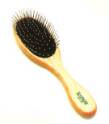
- Pin Brush
-
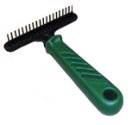
- Rake
-
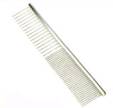
- Comb with graduated teeth
Method
The dog can be either standing or laying down on one side, which ever is easiest and more comfortable for you. When grooming a puppy, it’s usually easier to lay the dog on its side, so he can reach his chew object or toy without running away. To groom for showing, people use a grooming table and have the dog standing. The dog is at a convenient height on the table, and won’t mess the hair that’s just been brushed by rolling over. Start with the comb, then finish with the brush. To use the comb effectively, start at the bottom of the section you wish to groom, use your left hand (assuming you’re right handed) to push the hair against the natural growth, and comb down in the direction of the hair growth. Then push your hand upwards about 2 inches and comb down the next section that appears. Keep combing each section until no more hair comes out, then move up to the next section.

Jenny’s Sammy, Prince
You’ll find patches where the dog is shedding more than some other spots. It might be wise to do these twice or, if you don’t have time to groom the complete dog, just brush the areas that you know are the worst. For example, my dog’s highest shedding areas are his chest and pants (the side and rear of his back legs). I can tell when he needs a groom, not because he has knots, but because when I put my fingers in the fur in those areas, it feels “lumpy” underneath. These lumps are the undercoat which has come loose. This loose undercoat is what causes knots because it gets trapped and mats. Once you’ve finished going over the whole dog with the comb, do each area with a brush – the hair sticks to the brush much better than the comb and you’ll get all the strays that way.
The most effective way to use the brush is in the same manner as the comb, but it will still work if you just brush over the top coat (in the same manner that you’d brush your own hair). According to the Samoyed breed standard, the outer coat is supposed to stand out from the body. To achieve this look, simply do the final brush in the opposite direction to the lay of the coat, still using the section by section method.
While the dog is shedding or “blowing” coat (once per year for dogs and twice per year for bitches) always groom before you bath, or the loose hair will turn into knots during the bathing process. Then groom again after the dog is completely dry.
The Professionals
If you’re really pressed for time or the dog is particularly dirty or knotty, you can send him to a professional groomer. It will cost, but you will get a professional job. If they can do the initial groom, it should be quite easy to keep the coat under control yourself.
Clipping
Clipping or shaving the Samoyed coat is definitely NOT recommended. Their coat insulates them from the heat and the cold and protects their pink skin from the sun. Clipping the coat can interfere with the dog’s ability to regulate its body temperature and could have deadly consequences.
If the coat has become matted, and the mats are too painful to comb out, cutting the mat out is OK for the sake of the dog’s hygiene and comfort. If you have to cut out a mat, do it very carefully, a little bit at a time, to avoid cutting the dog’s skin. Be especially careful if the mat is near the skin. Instead of trying to cut the whole mat out, cut into the mat, then try gently combing the area. Then do a little more. Or, take the dog to a professional groomer.
There are cases where Samoyeds come into rescue so filthy and matted that shaving them is the only option. But in ordinary circumstances, to put it bluntly – if you don’t have the time, money or energy to keep a Samoyed coat clean and groomed, then the Samoyed is NOT the dog for you!
Trimming
First, for a pet Samoyed, you have the option of not trimming the coat at all. But you may want to do some trimming to help keep the dog clean.
Second, when using scissors on your dog, you can’t be too careful. Be patient and gentle. Always know exactly where the entire length of the scissors are and exactly what you will be cutting. Don’t just assume you know, even if you can’t see the scissors past the dog’s hair, and hope for the best. The result could be a nasty cut. Especially, be sure you can see the tips of the scissors. Keep the scissors parallel to the dog’s skin, not pointing toward the skin. Never cut close to the skin. And remember, your dog may jerk right when you are cutting, so be prepared. “Better safe than sorry.”
Hocks
You may want to trim the hocks (the back of the rear legs, above the feet) to keep them from matting and collecting dirt. First comb out the hocks and get out any mats. Then lay the scissors straight along the length of the hock, (parallel to the hock), about an inch to an inch and a half from the leg, and carefully trim off the long hair in a straight line. Try to trim the hair as evenly as possible. It helps to re-comb the hair and look at the hocks from a couple of different angles while you are trimming. The result will be a nice, even, “rounded” look.
Feet
Top of the foot:
Trim the long hair on the feet to keep it from collecting dirt, foxtails, etc. The best way to get the top of the feet trimmed evenly is to stand the dog on a table, grooming table, or any other hard surface where the dog is raised enough that you can comfortably see its feet. Comb out the hair on the feet. Look at the foot and very carefully trim back the long, scraggly hair. It may help to hold the scissors parallel to the table. You don’t need to trim close to the foot; just trim enough to neaten the hair. Then move on to another foot. Or, if your dog is tired of standing, give him a break before you do another foot.
Bottom of the foot:
You may also want to trim the long hair between the pads on the bottom of the feet. Whether or not you plan to trim the hair, it’s a good idea to comb out the hair and remove mats. You might be surprised what your dog has picked up, such as foxtails or gravel.
Some people feel long hair on the bottom of the foot gives the dog better traction, while some feel it decreases traction. I think it probably increases traction on surfaces such as snow, but decreases it on slick surfaces such as linoleum.
If you want to trim this hair (or if your breeder suggests you do it), be extra careful not to cut the pads. Injuries to the pads can be hard to heal. Use short scissors with rounded tips for safety. First trim off any very long hair. Then lay the scissors even with the pad (or a little above it) and trim the hair even with the pad. Don’t try to trim down in between the pads.
“Bikini cut”
Another area you may want to trim is under the anus, to help the dog stay clean. Again, be very careful not to cut the skin. Hold the scissors parallel to the skin, be sure you know exactly what hair you are trimming, and trim a little bit at a time. If you’re not sure how to do this, or not comfortable, ask your vet or groomer to show you.
Another option is to use a pair of clippers to clip the hair. If you are not experienced using clippers, ask your groomer or vet to show you first.
Extras
Apart from care of the coat, there are other things you need to do for the grooming to be complete. Nails will need to be clipped from time to time, especially if your dog is not doing much walking on concrete surfaces. Samoyeds have dew claws that need cutting. The dew claw is like the dogs thumb. Some breeds have 4 dew claws (one on each leg), and some have none, Samoyeds have 2 (one on each of the front legs). If the dew claw is left to grow freely, it will eventually grow around and back into itself, which is very painful for the dog, and will require surgical remedies which can be expensive. When clipping nails be sure not to clip into the pink area inside the nail. If unsure get your vet or groomer to clip the nails for your. You may be more comfortable just using a file, but you’ll need to do this more regularly than clipping as filing is a slower process.

Nail Clippers
Apart from what’s been mentioned, you will find many more pieces of equipment that can be purchased (i.e., slicker brush, flea comb, shedding blade, mat splitter, and more). Feel free to try them if you wish, but what I have suggested should see you through.
 Samsmiles
You must be logged in to post a comment.